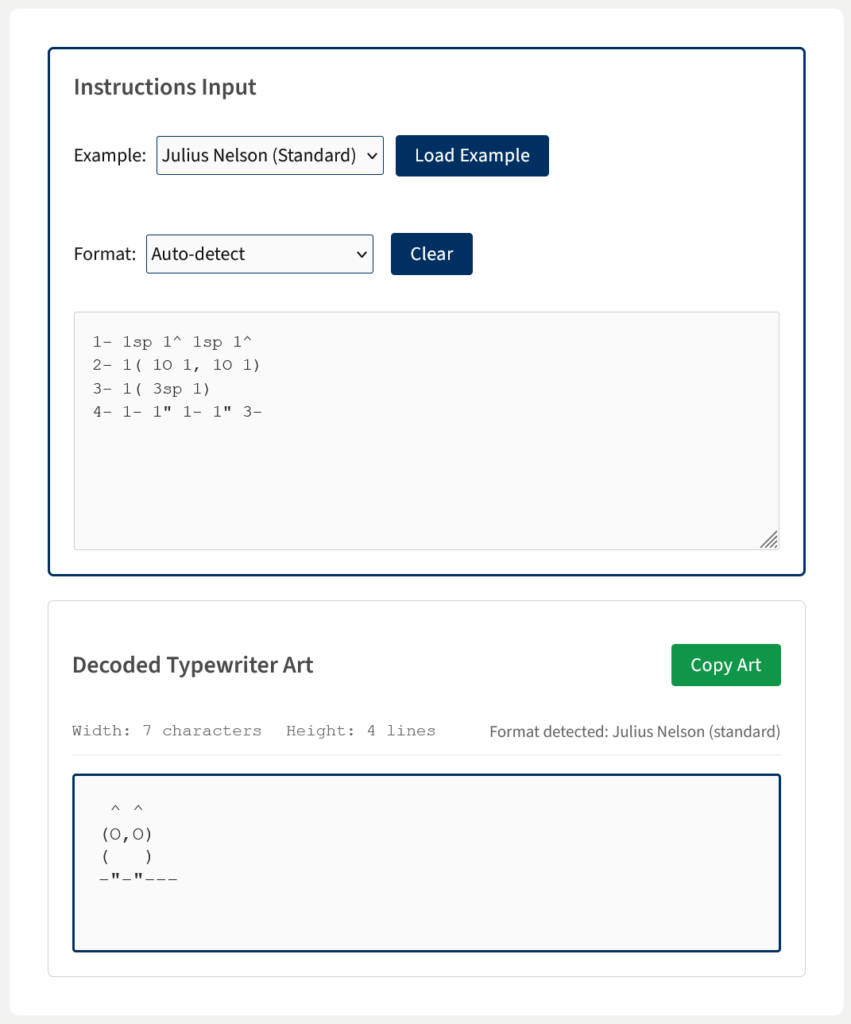
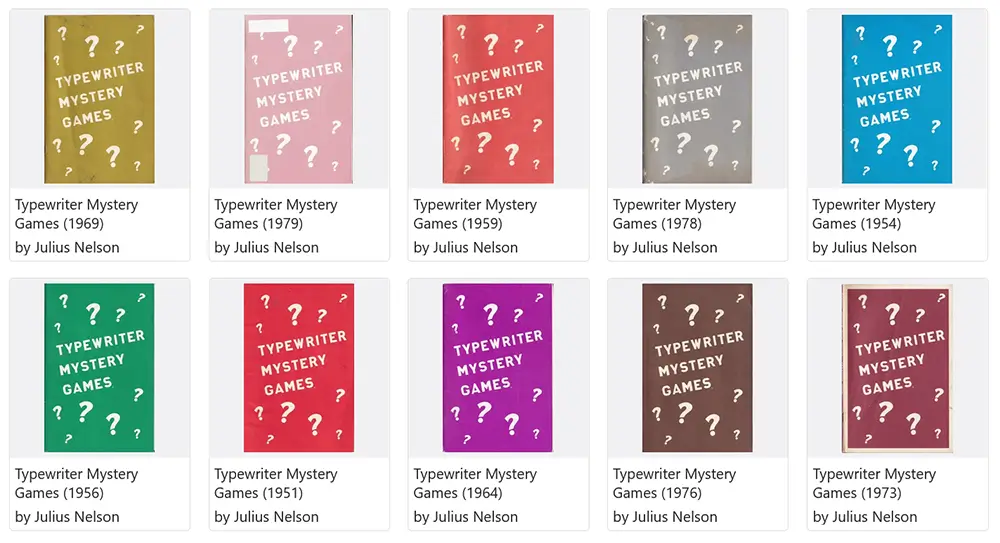
The Hanttula Typeworks’ Typewriter Art Decoder received a significant upgrade today to help typists solve mysteries that have plagued us since the 1950s. Mysteries, specifically from the works of Julius Nelson, a mid-century author who created a series of “Typewriter Mystery Games” — sets of text “instructions” to type a certain series of characters & lines on a mechanical typewriter which would result in a visual solution of a typewriter-rendered image.
Similarly, other authors like Madge Roemer (“Fun with Your Typewriter,” 1956) & Bob Neill (“Bob Neill’s Book of Typewriter Art”, 1982 and “Bob Neill’s Second Book of Typewriter Art”, 1984) created interesting documentations, experiments, references, and games around these types of written typewriter art instructions.
As an example, a reader would be presented only with this text:
1—46sp, 3$
2—29sp, 7$, 6sp, 3$, 4sp, 1$
3—29sp, 4$, 12sp, 2$, 2sp, 1$
4—31sp, 1$, 15sp, 3$
5—21sp, 12$, 10sp, 6$
6—22sp, 9$, 2sp, 1$, 8sp, 1$, 2sp, 9$
7—20sp, 2$, 1:, 1$, 5:, 1$, 1:, 2$, 1sp, 1$, 6sp, 1$, 1sp, 2$, 3:, 1$, 5:, 2$
8—19sp, 1$, 4:, 1$, 3:, 1$, 4:, 1$, 1sp, 1$, 4sp, 1$, 1sp, 1$, 6:, 1$, 6:, 1$
9—18sp, 1$, 6:, 1$, 1:, 1$, 6:, 1$, 1sp, 1$, 2sp, 1$, 1sp, 1$, 7:, 1$, 6:, 1$
10—18sp, 1$, 7:, 1$, 2:, 6$, 2sp, 5$, 8:, 1$, 6:, 1$
11—18sp, 1$, 8:, 6$, 1:, 5$, 1sp, 2$, 15:, 1$
12—18sp, 1$, 15:, 1$, 6sp, 1$, 15:, 1$
13—19sp, 1$, 13:, 1$, 8sp, 1$, 13:, 1$
14—20sp, 2$, 9:, 2$, 10sp, 2$, 9:, 2$
15—22/, 9$, 14/, 9$, 18/
16—72/
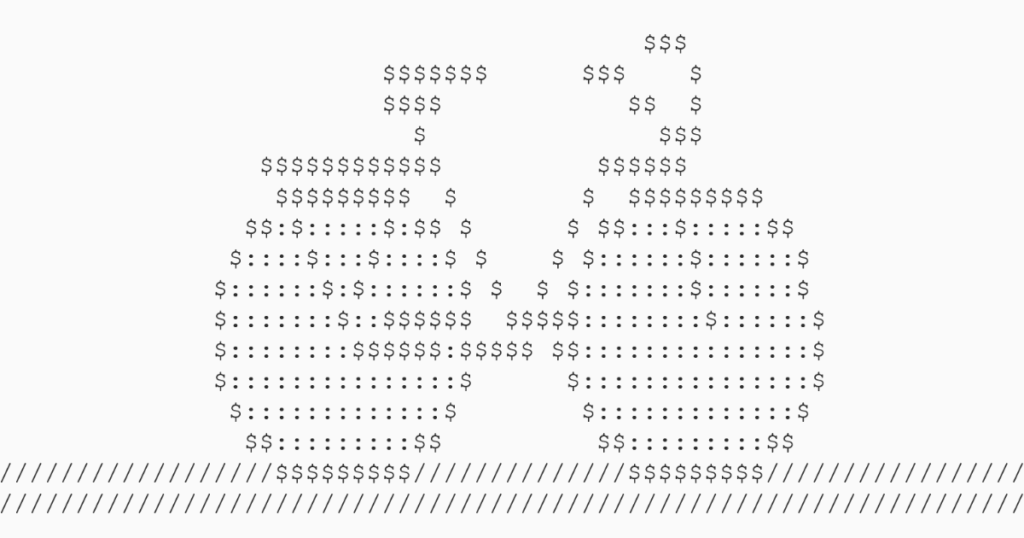
If followed faithfully on a mechanical typewriter, the typist would eventually get this visual answer to the ‘mystery’:
                                              $$$
                             $$$$$$$      $$$    $
                             $$$$            $$  $
                               $               $$$
                     $$$$$$$$$$$$          $$$$$$
                      $$$$$$$$$  $        $  $$$$$$$$$
                    $$:$:::::$:$$ $      $ $$:::$:::::$$
                   $::::$:::$::::$ $    $ $::::::$::::::$
                  $::::::$:$::::::$ $  $ $:::::::$::::::$
                  $:::::::$::$$$$$$  $$$$$::::::::$::::::$
                  $::::::::$$$$$$:$$$$$ $$:::::::::::::::$
                  $:::::::::::::::$      $:::::::::::::::$
                   $:::::::::::::$        $:::::::::::::$
                    $$:::::::::$$          $$:::::::::$$
//////////////////////$$$$$$$$$//////////////$$$$$$$$$//////////////////
////////////////////////////////////////////////////////////////////////
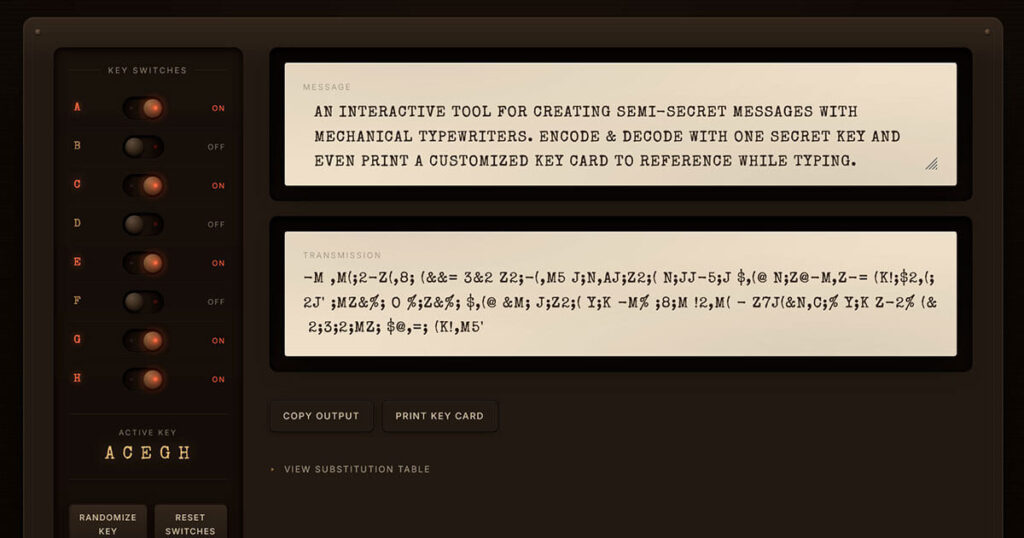
To make the use, exploration, and even creation of such typewriter art pieces easier, I’ve updated the Typewriter Art Decoder to now interpret the encoding styles (the written formats) of Julius Nelson and Madge Roemer – even including Madge Roemer’s use of the backspace to overlay characters into unique, interesting combinations. Bob Neill’s method utilizes line overlapping which will require a separate tool to render. I’ll work on that at some future time.
For now, the updated Typewriter Art Decoder is ready for you to try today!